
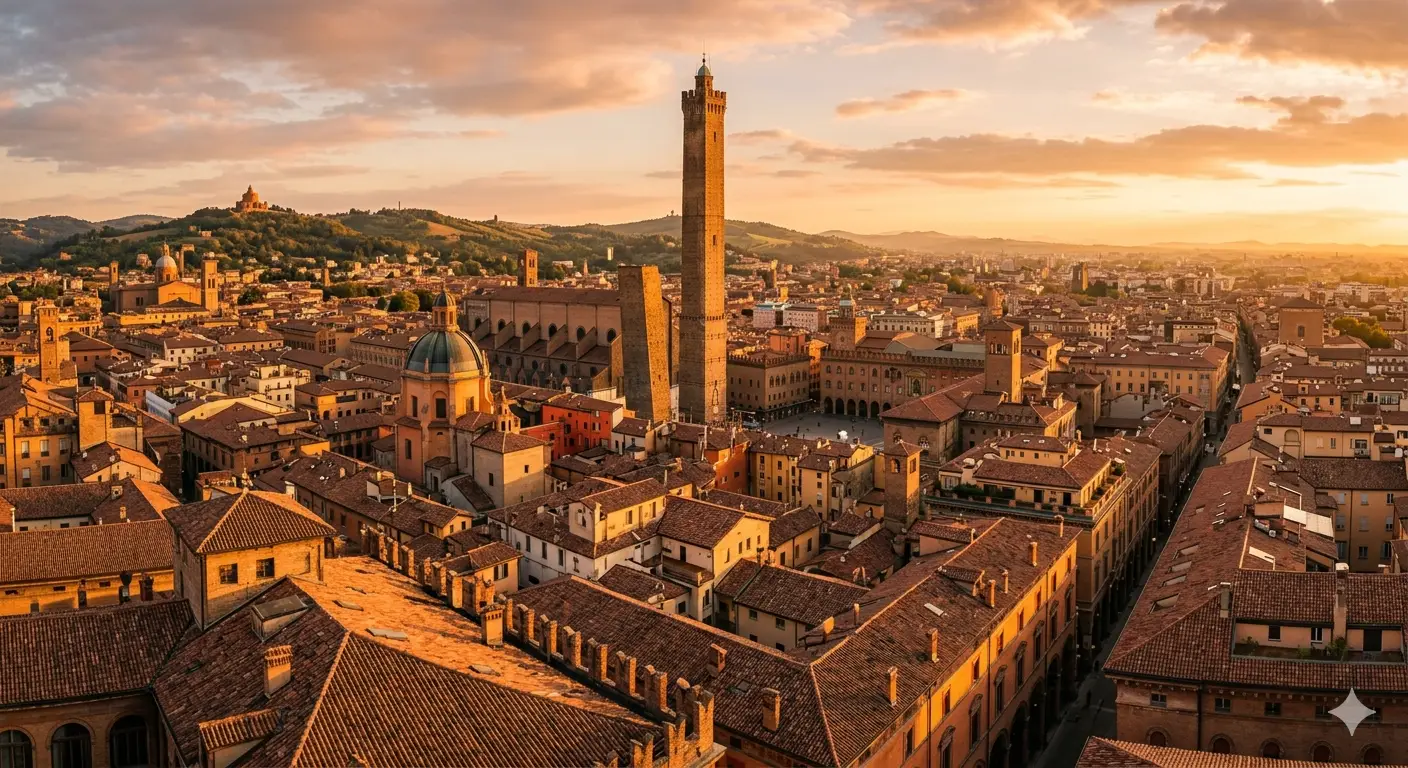
Bologna is one of Italy’s most beloved cities: fat, learned, red — la grassa, la dotta, la rossa, as the saying goes. But behind these three nicknames lies a universe of curiosities that few truly know. Whether you’ve lived here for generations or you’re planning your first visit, these 15 facts about Bologna will surprise you — guaranteed.
The world’s oldest university is in Bologna
It’s not a myth: the University of Bologna, founded in 1088, is considered the oldest university in the world still in operation. Before Christopher Columbus was even born, scholars in Bologna were already debating Roman law, medicine and philosophy. Today it has over 90,000 students and gives the city its distinctive intellectual energy.
Bologna’s porticoes are a UNESCO World Heritage Site
With 62 kilometres of urban porticoes, Bologna holds a world record. Since 2021, the porticoes of Bologna have been officially listed as UNESCO World Heritage. The tradition dates back to the Middle Ages: private owners extended the upper floors of their houses over the public street, creating covered galleries where city life carried on sheltered from rain and sun. The Portico di San Luca, at 3.8 km and 666 arches, is the longest covered portico in the world.
The Asinelli Tower leans — and you can still climb it
Bologna has two medieval towers that symbolise the city: the Asinelli Tower (97.2 m) and the Garisenda Tower (48 m). Both lean. The Garisenda is so tilted — over 3 metres out of plumb — that it was shortened for safety reasons back in the 14th century. Dante mentioned it in the Divine Comedy. The Asinelli Tower can still be climbed: 498 steps for a breathtaking view over rooftops and porticoes.
Asinelli Tower: 97.2 m tall, 498 steps, ~1.3 m lean · Garisenda Tower: 48 m (shortened from 60 m in 1300), 3.22 m lean · Built: early 12th century · Literary reference: Dante, Inferno – Canto XXXI
Mortadella was born here — and it has its own protected status
Mortadella Bologna IGP has no upper weight limit: the largest one ever made weighed over 1,200 kg. The original recipe dates back to the 17th century: finely ground pork, lard, spices and pistachios. Those little flecks of fat aren’t a flaw — they’re the signature.
Bologna has a visitable underground canal system
Beneath the streets of the historic centre, medieval canals still flow — once part of a water system that powered mills and dye works. The Reno canal and the Navile canal are still partly visible, and in some spots you can see water running through grates in the pavement. Guided tours let you explore this forgotten hydraulic network.
“Bologna is a city that reveals itself slowly: the more you know it, the more it surprises you. Its secrets aren’t on display — they’re under the porticoes, underground, between the pages of history.”
The original Bolognese ragù barely contains tomato
The official registered recipe for ragù alla bolognese — filed by the Confraternita del Tortellino with the Bologna Chamber of Commerce in 1982 — calls for beef, pancetta, onion, carrot, celery, white wine, milk and just a touch of tomato purée. No spaghetti either: proper Bolognese ragù is served with egg tagliatelle. The perfect tagliatella width? About 8 mm — precisely 1/12,270th of the height of the Asinelli Tower.
Italy’s most famous Neptune is in Bologna
The Fountain of Neptune, created by Giambologna in 1566, is one of the Renaissance’s great masterpieces. The pope of the time was reportedly so scandalised by its anatomical realism that he demanded changes. Giambologna found a clever workaround: positioning the god’s thumb in just the right way creates a surprising optical illusion — visitors still try to find the right angle.
Bologna was the first Italian city with public lighting
In 1796, under Napoleon, Bologna became the first Italian city to install a public street lighting system using oil lamps — a forgotten first that says a lot about the city’s practical, innovative spirit.
Tortellini come with a love legend
Legend has it that tortellini were invented by an innkeeper inspired by the navel of Lucrezia Borgia (or the Virgin Mary, depending on the version). Tortellini di Bologna follow precise dimensions: paper-thin pasta filled with pork loin, prosciutto, mortadella, Parmigiano Reggiano and nutmeg — and they must be served in capon broth.
One of Italy’s first railways ran through Bologna
In 1844, the Bologna–Padua railway line opened — one of the first in Italy. Today, Bologna Centrale is Italy’s second-busiest rail hub, a key junction on the high-speed line between northern and southern Italy.
Bologna’s red colour isn’t paint
The reddish hue of Bologna’s buildings comes from terracotta brick typical of the Po Valley, fired with local iron-rich clay that gives it that characteristic orange-red tone. That’s where the nickname “la Rossa” — the red one — comes from. Every building in the historic centre follows this centuries-old building tradition.
One of Europe’s first computers was built in Bologna
In 1955, the University of Bologna built the Elea, one of Italy’s first electronic calculators. Today, Bologna is home to CINECA, one of Europe’s most powerful supercomputing centres.
Europe’s oldest trade fair started near Bologna
The Fiera di San Bartolomeo, one of Europe’s oldest trade fairs, was already taking place in the area around Bologna in the 13th century. The modern BolognaFiere exhibition centre is the direct heir to this centuries-old tradition.
San Petronio isn’t buried in his own basilica
The Basilica of San Petronio in Piazza Maggiore has the fifth-tallest vault among Gothic churches in the world. But San Petronio himself isn’t buried there — his relics rest in the Basilica of Santo Stefano, in the so-called “Bologna Jerusalem,” a complex of seven medieval churches.
Bologna is Italy’s food capital
Emilia-Romagna has the highest number of Michelin stars per capita in Italy, and Bologna is its culinary capital. Between historic trattorias, century-old delis and innovative restaurants, eating well in Bologna isn’t a possibility — it’s a certainty. Mercato di Mezzo and the Quadrilatero district are the perfect places to start exploring.
Where to stay in Bologna: the perfect base to explore the city
If these facts have sparked your curiosity to come and discover Bologna in person, choosing where to stay makes all the difference. Bologna Fair Tower, at Via Cleto Tomba 21, is a five-minute walk from BolognaFiere — ideal for anyone who wants to explore the city at their own pace and return to a comfortable base after a day among porticoes, towers and tagliatelle. The historic centre is just 15 minutes by bus or a 25-minute walk along the porticoes.
Bologna Fair Tower — 5 minutes from the fairgrounds
Discover Bologna from the perfect base
Rooms with private bathroom, breakfast included, free Wi‑Fi. Just 25 minutes on foot from the historic centre along the porticoes.
Check AvailabilityDirect booking — no commission fees · Flexible cancellation available